Test Capabilities
Where Product Performance Is Proven
Test Capabilities
Testing is not where product quality begins.
It is where product performance, manufacturing execution, and design intent are verified.
At SMT, test is not treated as a final checkpoint added at the end of production. It is part of the product execution system — connected to engineering, prototyping, NPI, manufacturing, quality, and higher-level assembly.
That matters because the best time to think about test is before the product is difficult, expensive, or impossible to test.
SMT helps customers develop and execute test strategies that support real product performance, repeatable production, and long-term reliability.
Testing Should Start Before Production
Many product issues become expensive because test is considered too late.
A product may function in the lab, but still create problems in production if:
- Test access was not considered during design
- Firmware does not support production validation
- Functional requirements are not clearly defined
- Fixture needs are not planned early enough
- Failure modes are difficult to isolate
- Test coverage is incomplete
- Operators do not have clear workflows
- Results are not tied back to process improvement
At SMT, test strategy is aligned early so customers can reduce debug cycles, improve coverage, and support a cleaner transition from prototype to production.
Part of a Connected Execution System
est at SMT connects across the full product path:
Engineering
Design for Test, test access, firmware test hooks, product requirements, fixture planning, and validation strategy.
Prototyping
Early validation, fault isolation, build feedback, and test learning before production ramp.
NPI
Alignment of test coverage, fixtures, documentation, operator workflow, and production readiness.
Manufacturing
Consistent execution of ICT, functional test, AOI, X-ray, programming, validation, and defined production test processes.
Higher-Level Assembly
System-level functional test, final configuration, serialization, and finished product validation where required.
The goal is consistency from the first build through full production.
Why Test Matters
Test is not simply about finding defects.
It is about proving that the product performs as intended and that the manufacturing process can produce that result repeatedly.
A strong test strategy helps customers:
- Identify issues earlier
- Validate system performance
- Improve fault isolation
- Reduce debug time
- Support scalable production
- Reduce rework and warranty exposure
- Protect long-term product reliability
- Improve confidence during production ramp
Our Testing Capabilities
In-Circuit Testing
ICT supports component-level and board-level validation by checking for shorts, opens, component values, polarity, placement-related issues, and electrical integrity.
For the right products, ICT can provide fast fault isolation and help identify manufacturing or component-related issues before they move downstream.
SMT supports in-circuit test as part of a broader production test strategy, not as a standalone checkbox.
Functional Testing
Functional test validates whether the assembly or product operates according to defined customer requirements.
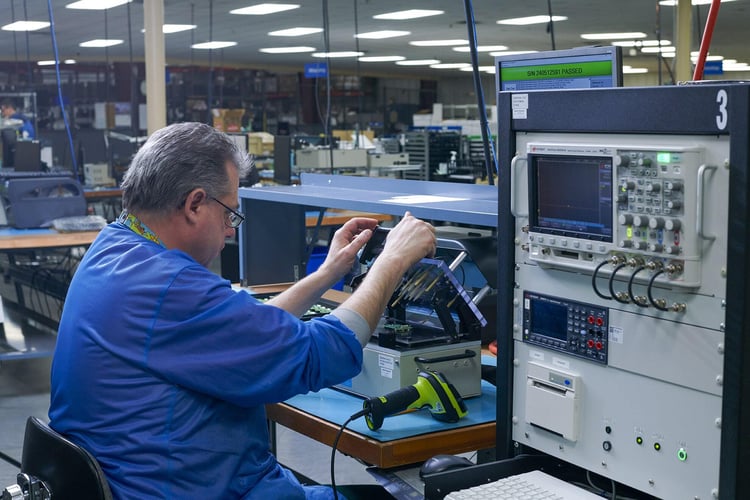
SMT supports functional test using customer-defined protocols, SMT-developed test approaches, custom fixtures, automated test platforms, software-controlled instrumentation, and product-specific validation workflows.
Functional test helps verify real product behavior after assembly.
Design for Test
Design for Test helps improve test coverage before the product reaches production.
SMT reviews test access, fixture needs, firmware hooks, functional requirements, connector strategy, fault isolation, and production validation requirements earlier in the design process.
This helps reduce redesign risk and improve production readiness.
Test Strategy Development
SMT helps customers determine what should be tested, when it should be tested, how failures should be identified, and how the test process should scale from prototype to production.
A strong test strategy considers risk, coverage, product requirements, production volume, operator workflow, data capture, fixture design, and long-term support.
Test Deployment
A test process is only useful if it can be executed consistently.
SMT supports deployment of test fixtures, test software, operator instructions, workflows, production documentation, and escalation paths so testing can be repeated reliably build after build.
Automated Test Platforms
SMT supports automated functional test platforms that use controlled instrumentation, software-driven sequences, fixtures, and defined pass/fail logic to improve consistency and reduce operator variation.
Automation helps create repeatable validation for products that require structured production test.
Custom Fixture Development
Many products require test fixtures designed around the specific assembly, interface, product behavior, or system requirement.
SMT supports fixture planning, design input, build support, validation, and deployment for production test environments.
Optical and System-Level Integration
Some products require validation beyond standard electrical checks.
SMT can support test strategies involving optical integration, system-level validation, final configuration, and higher-level assembly test requirements where applicable.
Built for Execution
SMT does not treat testing as a disconnected checkpoint.
We treat test as part of the execution system that helps confirm what was designed, built, inspected, and shipped.
That means test feedback can support:
- Engineering improvements
- Manufacturing process refinement
- Supplier or component issue identification
- Root-cause analysis
- Production yield improvement
- Better customer communication
- Long-term product support
The purpose of testing is not just to catch problems.
The purpose is to make the product and the process stronger.
Where Test Programs Often Struggle
Test programs often become difficult when:
- Test is added after the design is complete
- Test access is limited or unavailable
- Functional requirements are unclear
- Firmware does not support production validation
- Fixtures are developed too late
- Fault isolation is poor
- Operators lack clear test instructions
- Test results are not connected to process feedback
- Prototype test methods do not scale into production
- Final assembly validation is not considered until the product is already built
SMT helps customers address these issues earlier.

In-Circuit Testing (ICT)
Verifies individual component values, shorts/opens, and digital functions with fast fault isolation - ideal for mid-to-high volume production. Supports boundary scan and JTAG testing for complex PCBs.
Functional Testing
Simulates real-world operation scenarios using custom-designed fixtures and software to detect system-level issues post-assembly.
Design for Test (DFT)
Early DFT reviews improve coverage, reduce cost, and ensure smooth fixture development. By addressing testability up front, we help you avoid redesigns and accelerate time-to-market.
Test Deployment
Robust deployment ensures test strategies scale seamlessly from prototype to production. With documented workflows, fixtures, and operator guidance, every build stage stays consistent and reliable.
Engineering Resources
Our multidisciplinary team brings expertise in electrical, firmware, and fixture engineering. From optical integration to root-cause analysis, we provide the technical depth to solve complex test strategies.
Test Strategy Development
We build test roadmaps that evolve from prototype through production, ensuring consistent coverage at every stage. With risk-based planning and clear KPIs, your product launches with measurable confidence.
What Makes SMT Different
Test Strategy Aligned With Product Design
Testing begins with understanding the product requirements, risk areas, interfaces, and how the product is expected to perform.
Connected to Engineering and Manufacturing
Test is aligned with design, sourcing, prototyping, production, inspection, quality, and higher-level assembly.
Production-Test Mindset
SMT helps customers think beyond “does it work once?” toward “can it be tested consistently in production?”
Custom Test Capability
SMT can support product-specific fixtures, automated functional test, software-controlled instrumentation, and defined test workflows.
Feedback Into Process Improvement
Test results are not treated as isolated events. They help identify issues, support root cause, and improve manufacturing execution.
Scalable From Prototype to Production
Test approaches can evolve from early validation into repeatable production test processes as the product matures.
- Test strategy aligned with how products are built
- Integration across engineering, production, and supply chain
- Real-time feedback into process improvement
- Consistent execution from first build through volume
Who SMT Test Capabilities Are Built For
SMT is a strong fit for OEMs that:
- Need reliable production test execution
- Are developing products that require functional validation
- Need support with Design for Test
- Have experienced field failures, false passes, or weak test coverage
- Need custom fixtures or automated test platforms
- Are moving from prototype to production
- Require system-level or higher-level assembly validation
- Want test connected to engineering and manufacturing execution
Prove Performance Before It Reaches the Field
A product should not rely on hope, inspection alone, or field feedback to prove that it works.
SMT helps customers build test strategy into the product execution path so performance can be verified earlier, more consistently, and at production scale.
If your product needs to be tested, validated, and built with confidence, SMT can help define the path.
Engineering
Rapid Prototyping
Manufacturing
Higher-Level Assembly
Define the Right Test Strategy

How AI is Reshaping Electronics Manufacturing

Most EMS Partner Selections Miss The Mark - Here's Where They Go Wrong